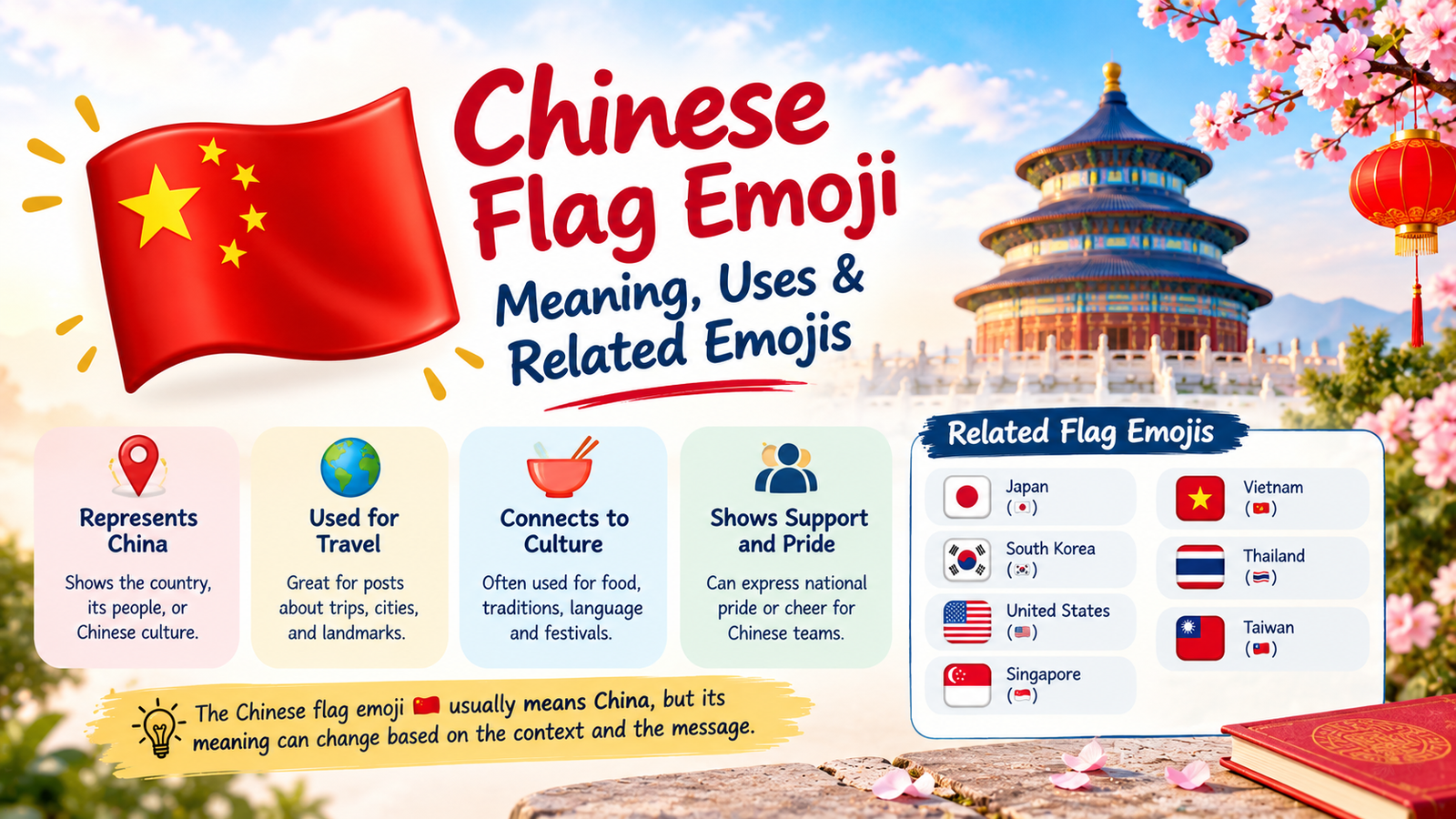
The Chinese flag emoji 🇨🇳 is a simple way to represent China in texts, social media posts, and online conversations. Whether you’re talking about Chinese culture, planning a trip to China, celebrating a sports victory, or learning Mandarin, this emoji helps you share your message quickly. Its bright red background and five golden stars make it easy to recognize. But what does 🇨🇳 really mean, and when should you use it? In this guide, you’ll learn the Chinese flag emoji’s meaning, common uses, examples for everyday messages, and how it compares with other country flag emojis.
Complete Publish-Ready Article
The Chinese flag emoji 🇨🇳 represents China, its national flag, and connections to the country. People use it when talking about Chinese culture, travel, nationality, food, language, sports, holidays, and events involving China. Depending on the message, it can also express national pride or show support for a Chinese team or achievement.
Its meaning is usually straightforward, but the surrounding conversation matters. Someone sharing travel plans may use 🇨🇳 to identify a destination, while a sports fan might add it to a message celebrating China’s performance.
Quick Answer: What Does the 🇨🇳 Emoji Mean?
The 🇨🇳 emoji is officially known as Flag: China. It commonly represents China, Chinese identity, travel to China, Chinese culture, and events connected to the country.
For example:
- “I’m visiting Beijing next month 🇨🇳” — The flag identifies the travel destination.
- “Learning Mandarin 🇨🇳” — It connects the message with China and the Chinese language.
- “What a great performance by China! 🇨🇳” — It expresses support for a Chinese team or competitor.
The emoji does not automatically indicate someone’s nationality, political views, or personal beliefs. Those meanings depend on the person and the conversation.
What Does the Chinese Flag Emoji Represent?
The Chinese flag emoji shows the national flag of the People’s Republic of China. The flag has a red background with five yellow stars near the upper-left corner.
In everyday messages, 🇨🇳 can communicate several closely related ideas.
China as a Country
The most direct meaning is China itself. People often add the flag to messages about Chinese cities, geography, news, travel destinations, or international events.
Example:
“Shanghai is on my travel bucket list 🇨🇳”
Here, the emoji identifies the country the person wants to visit.
Chinese Culture and Traditions
The flag may accompany conversations about Chinese traditions, festivals, food, history, art, or cultural experiences.
Example:
“Trying homemade dumplings for the first time! 🇨🇳”
The flag adds a connection to Chinese food culture. It does not mean that every dish mentioned is exclusive to China.
Chinese Language and Learning
People may use 🇨🇳 alongside posts about studying Mandarin, practicing Chinese characters, or exploring language-learning resources.
Example:
“Practicing my Chinese characters every day 🇨🇳”
The flag gives the message a national context. However, Chinese is spoken in many communities outside mainland China, so the emoji does not represent every Chinese-speaking person or community equally.
National Pride and Achievements
The emoji can express pride in China or celebrate an accomplishment associated with the country.
Example:
“Congratulations to the Chinese athletes on their performance! 🇨🇳”
In this context, the flag reinforces the connection between the achievement and China.
Travel and Tourism
Travelers use the Chinese flag emoji in itineraries, vacation captions, destination lists, and travel updates.
Example:
“Next stop: the Great Wall of China 🇨🇳”
The meaning is literal and easy to understand because the message names a well-known Chinese landmark.
How People Use 🇨🇳 in Text Messages and Social Media
The Chinese flag emoji is useful when you want to identify China without repeatedly writing the country’s name. It can appear at the beginning or end of a message, in a caption, or beside other relevant emojis.
Here are some natural examples.
| Example message | Likely meaning |
|---|---|
| “Hello from China 🇨🇳” | The sender is sharing a location or travel update. |
| “Beijing looks incredible! 🇨🇳” | Excitement about a Chinese city or destination. |
| “Learning Mandarin 🇨🇳📚” | Studying the Chinese language. |
| “Chinese food night 🥟🇨🇳” | A meal or gathering inspired by Chinese cuisine. |
| “Watching the match tonight 🇨🇳⚽” | Following a Chinese team or a match involving China. |
| “Happy Chinese New Year! 🧧🇨🇳” | Connecting the greeting with Chinese cultural traditions. |
These are illustrative examples, not fixed definitions. A flag can help clarify a message, but the words around it usually provide the most important details.
Does the Chinese Flag Emoji Have Different Meanings in Different Contexts?
Yes. Although 🇨🇳 consistently identifies China, its conversational meaning can shift with the subject and tone of the message.
In Friendly Conversations
Friends might use the flag when discussing vacations, restaurants, language learning, cultural interests, or plans to visit China.
For example:
“Found a great Chinese restaurant downtown 🇨🇳”
The emoji adds a country-related reference. It does not necessarily express national pride or make a political statement.
In Sports Discussions
Sports fans may use 🇨🇳 when discussing Chinese athletes, national teams, competitions, or results.
For example:
“China played really well today 🇨🇳👏”
The flag identifies the team or country being discussed, while the clapping emoji adds praise.
In News and Political Discussions
The flag may appear in messages about China’s government, international relations, trade, public policy, or other news topics.
For example:
“Following the latest news from China 🇨🇳”
The emoji identifies the country under discussion. It does not reveal whether the sender agrees or disagrees with a particular policy.
In Jokes or Sarcasm
Like other flag emojis, 🇨🇳 can appear in a joke, ironic comment, or sarcastic message. The tone comes from the words, the relationship between the people communicating, and the wider conversation.
For example:
“Guess who’s planning another trip to China 🇨🇳😂”
This could be a playful announcement rather than a serious statement.
Important: Do not assume the emoji is sarcastic, political, or offensive just because it appears in a particular conversation. Look at the complete message before interpreting it.
Related Flag Emojis and Their Meanings
The Chinese flag emoji is one of many country flag emojis. The following flags can be useful for identifying other countries or comparing flags that may appear in similar conversations.
| Emoji | Official Name | Common Meaning | Tone | Where or When It Is Used |
|---|---|---|---|---|
| 🇨🇳 | Flag: China | China, its national flag, or related topics | Neutral or proud | China travel, culture, news, and national events |
| 🇯🇵 | Flag: Japan | Japan and Japanese-related topics | Neutral or enthusiastic | Travel, Japanese culture, food, and sports |
| 🇰🇷 | Flag: South Korea | South Korea and Korean-related topics | Neutral or enthusiastic | Travel, Korean culture, music, and sports |
| 🇺🇸 | Flag: United States | The United States and American-related topics | Neutral or patriotic | US travel, national events, and American sports |
| 🇸🇬 | Flag: Singapore | Singapore and its national identity | Neutral or proud | Travel, city guides, and Singapore-related events |
| 🇻🇳 | Flag: Vietnam | Vietnam and Vietnamese-related topics | Neutral or proud | Travel, food, culture, and national events |
| 🇹🇭 | Flag: Thailand | Thailand and Thai-related topics | Neutral or enthusiastic | Tourism, Thai cuisine, and cultural discussions |
🇨🇳 vs. 🇯🇵: China and Japan
The 🇨🇳 emoji represents China, while 🇯🇵 represents Japan. Their flags look different: China’s flag has a red background with five yellow stars, while Japan’s flag has a red circle on a white background.
Use the Chinese flag for a reference to China and the Japanese flag for a reference to Japan. Neither emoji should be used as a substitute for the other.
🇨🇳 vs. 🇰🇷: China and South Korea
The 🇰🇷 emoji represents South Korea, not China. South Korea’s flag features a red-and-blue symbol in the center with black trigrams around it.
These emojis may appear in the same conversations about East Asian travel, food, culture, or international sports, but they identify different countries.
🇨🇳 vs. 🇹🇼: China and Taiwan
The 🇨🇳 emoji represents the flag associated with the People’s Republic of China, while 🇹🇼 is the Flag: Taiwan emoji.
These are distinct emoji sequences with different flag designs. Their use can carry political or identity-related significance in some contexts, so it is best to follow the specific country or place being discussed rather than treating the flags as interchangeable.
How to Copy and Paste the Chinese Flag Emoji 🇨🇳
You can copy the Chinese flag emoji below and paste it into a text message, social media caption, document, or compatible website.
Chinese Flag Emoji
🇨🇳
Official name: Flag: ChinaCopy Chinese Flag Emoji
If the flag does not display correctly on your device, your operating system, app, or font may not support its graphical presentation. Some systems may show the letters CN instead of a flag image.
Official Name and Unicode Details
The Unicode emoji reference uses the name Flag: China for 🇨🇳. It is a flag sequence rather than a single, standalone character.
Here are the key technical details:
- Emoji: 🇨🇳
- Official name: Flag: China
- Region code: CN
- Sequence: Regional Indicator Symbol Letter C followed by Regional Indicator Symbol Letter N
- Unicode code points: U+1F1E8 and U+1F1F3
- Emoji introduction: Added to Emoji 1.0 in 2015, according to Emojipedia.
Unicode flag sequences use pairs of regional indicator symbols to represent countries and certain other regions. The pair for CN is commonly rendered as China’s flag on supported platforms.
The Unicode standard defines the underlying characters and sequences, but it does not require every device to draw the flag identically. The exact design, dimensions, and rendering may differ between operating systems and apps.
Meaning, Copy And Paste
+2
Why Does the Chinese Flag Emoji Look Different on Some Devices?
The emoji’s general meaning stays the same across platforms, but its visual design can vary.
For example, a phone might display a detailed rectangular flag, while another service may use a slightly different shape, shading, or layout. Some systems may not render national flag emojis as images and instead show the country code.
These differences come from the software and emoji fonts used by each platform. They do not usually indicate a different meaning.
If you need to identify the emoji in plain text, look for the regional indicator sequence for CN rather than relying only on its appearance.
Frequently Asked Questions
What does 🇨🇳 mean?
The 🇨🇳 emoji represents China and its national flag. It is commonly used in messages about Chinese culture, travel, language, sports, news, and national events.
What is the official name of 🇨🇳?
Its official emoji name is Flag: China.
What does 🇨🇳 mean in a text from someone?
It usually identifies China or a topic connected to the country. The sender might be discussing travel, food, language, culture, sports, or current events. The emoji alone does not reveal the sender’s nationality or political beliefs.
Does 🇨🇳 mean someone is Chinese?
Not necessarily. A person might use it because they are Chinese, are visiting China, are learning Mandarin, enjoy Chinese culture, or are discussing a Chinese team. The emoji by itself does not establish anyone’s identity.
Is 🇨🇳 the same as the Japanese flag emoji?
No. 🇨🇳 represents China, while 🇯🇵 represents Japan. They have different flag designs and refer to different countries.
Why does the Chinese flag emoji sometimes appear as CN?
Some devices or software do not display the flag graphic. Instead, they may show the two-letter regional indicator representation, CN. This is a rendering or compatibility issue rather than a different emoji meaning.
Meaning, Copy And Paste
+1
When should I use the Chinese flag emoji?
Use 🇨🇳 when your message refers to China, a trip there, Chinese culture, language learning, a national event, or another clearly related topic. If you are discussing a different country, choose its flag instead.
Conclusion
The Chinese flag emoji 🇨🇳 is a simple way to identify China in messages, captions, travel posts, cultural discussions, and sports conversations. Its meaning is usually literal, though the surrounding text can add excitement, pride, humor, or political context. Use it when China is the subject, and avoid assuming that the flag reveals someone’s identity or beliefs.